

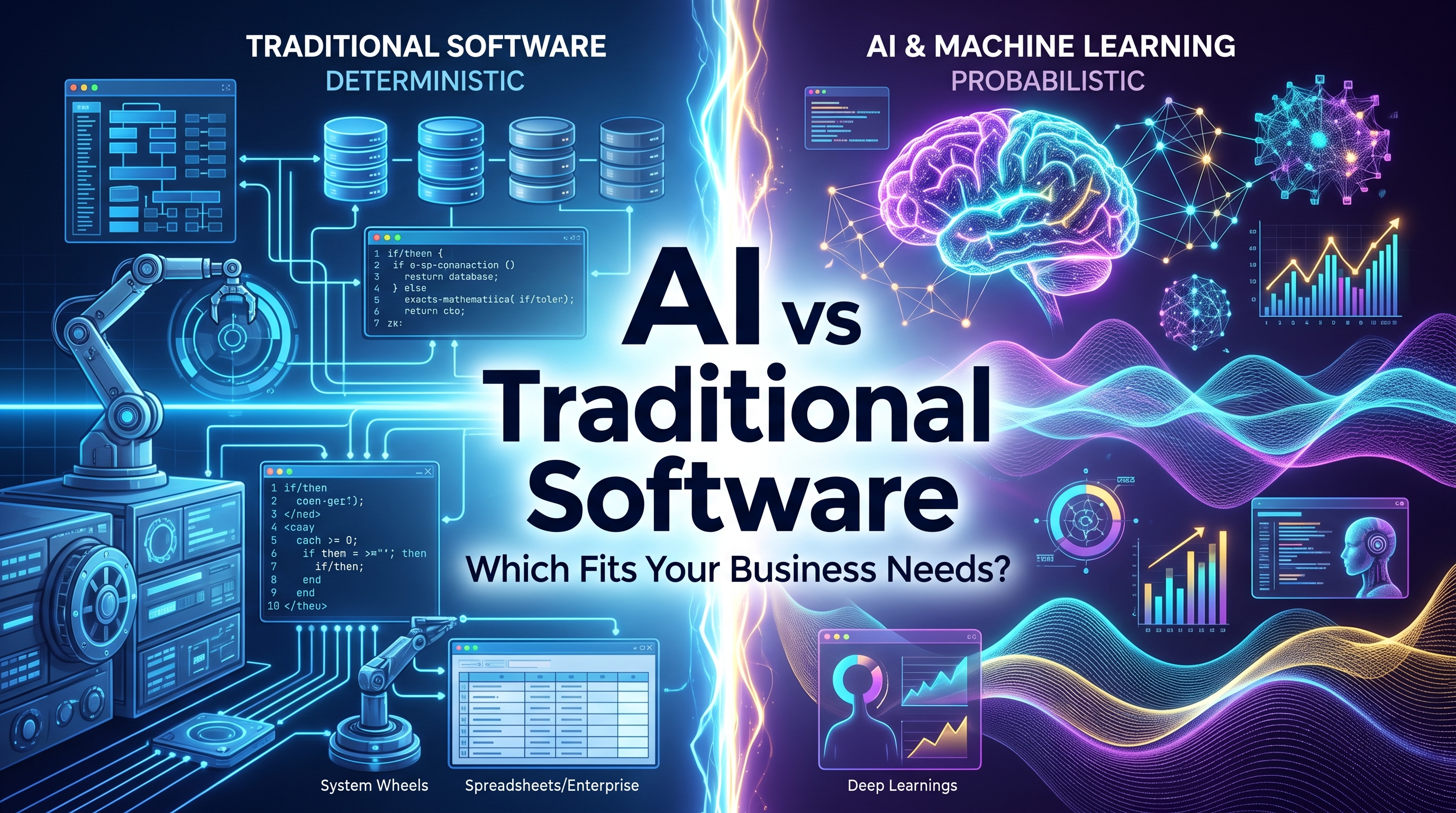
Every modern organization relies on digital infrastructure, but leaders face an evolving dilemma when evaluating ai vs traditional software for day-to-day operations. Conventional programs execute hardcoded rules to deliver repeatable outcomes. In contrast, modern artificial intelligence models interpret patterns to make probabilistic predictions. Understanding this fundamental divide enables executives to budget accurately, reduce implementation friction, and choose the correct technical architecture.
AI vs Traditional Software: Fundamental Architecture
The core difference between conventional code and machine learning lies in how instructions are processed.
Traditional business software uses deterministic logic. Programmers write explicit, conditional rules: if action A occurs, execute step B. Relational databases, enterprise resource planning (ERP) suites, and standard payroll engines operate this way. Because the parameters are strictly defined, these tools yield identical results from identical inputs every single time.
Artificial intelligence relies on statistical models trained on large datasets. Rather than following fixed lines of code, an AI application infers relationships among data points. Natural language processing, automated document extraction, and visual inspection algorithms make probabilistic assessments. They do not guarantee an identical, binary outcome, but instead return the most likely answer based on prior training.
Features |AI-Powered Software |Conventional Software |
| Logic Type| Deterministic (rule-based) | Probabilistic (pattern-based)|
| Input Dependency | Structured, clean tables | Structured, unstructured, or media |
| Outcome Nature | Consistent, predictable results | Dynamic predictions and estimates |
| Maintenance | Code updates and patches | Data retraining and pipeline tuning |
| Cost Profile | Predictable licensing fees | Variable compute and inference costs |
When Traditional Software Remains the Better Choice
Despite rapid advances in modern computing, conventional software remains superior for mission-critical tasks that require absolute precision.
Financial accounting provides a clear example. A business ledger requires exact figures. General ledger balancing, tax calculations, and payroll disbursements must follow legal standards down to the penny. A deterministic database prevents mathematical discrepancies because it cannot guess or hallucinate.
Regulatory compliance and transactional processing also benefit from rule-based architectures. Customer billing, inventory counts, and relational record lookups perform faster and cheaper when run through relational database management systems. These platforms avoid the computational overhead, inference latency, and probabilistic variance inherent to neural networks.
Where AI Adds Concrete Business Value
AI tools deliver significant value when applied to ambiguous, high-volume tasks that standard code cannot address.
Unstructured data processing is a primary strength. Conventional applications struggle to parse scanned contracts, customer support emails, or audio calls without strict formatting. Natural language models categorize inquiries, extract sentiment, and summarize key data points in seconds.
Predictive analytics and anomaly detection represent another distinct advantage. While a traditional spreadsheet can plot historical sales, machine learning models analyze multiple historical variables to forecast inventory demand or detect fraudulent payment attempts before transactions settle.
Core Implementation Trade-Offs: Cost, Accuracy, and Maintenance
Selecting an architecture requires balancing technical complexity against organizational readiness.
Upfront and Ongoing Costs: Traditional platforms generally involve predictable subscription fees or one-time licensing, paired with known hosting needs. AI systems involve training data preparation, integration pipelines, and ongoing cloud inference costs that fluctuate with query volume.
Accuracy versus Precision: Conventional software functions without ambiguity; it either executes as programmed or throws an error. AI systems require ongoing evaluation metrics, such as precision and recall rates, to manage occasional statistical errors.
System Maintenance: Standard IT staff maintain traditional code via scheduled bug fixes and API updates. AI systems demand monitoring for data drift, where performance degrades as real-world market conditions diverge from original training inputs.
Choosing the Right Approach for Your Stack
Most enterprises do not face an all-or-nothing decision. The most resilient technical stacks combine both paradigms strategically.
Use traditional software as your operational backbone. Keep your core financial tracking, human resources records, and primary databases on rule-based systems to ensure absolute compliance and data integrity. Layer artificial intelligence on top of this foundation to automate complex categorization, streamline customer interactions, and uncover trends hidden within unstructured data. Matching the tool to the specific operational challenge delivers maximum return on investment.
Frequently Asked Questions
Can AI completely replace traditional software?
No. Traditional software is necessary for tasks requiring exact, deterministic results, such as accounting, database management, and compliance logging. AI complements these applications rather than replacing them.
Is AI software more expensive than traditional applications?
AI software often requires higher ongoing maintenance expenses. Costs depend on API call volumes, specialized cloud hardware, and data preparation, whereas standard software typically relies on predictable licensing.
How can companies address errors caused by AI tools?
Organizations implement human-in-the-loop workflows. In these setups, personnel review low-confidence model predictions before decisions are finalized, while allowing high-confidence predictions to clear automatically.