
Complete SEO Article
best ai tools for small business
Selecting the right digital infrastructure often decides how quickly an organization scales. Small companies today must weigh adaptive intelligent platforms against deterministic legacy systems. Evaluating the **best ai tools for small business** operations requires understanding where generative and predictive algorithms outperform traditional applications, and where standard software remains essential.
How AI Tools Differ from Traditional Software
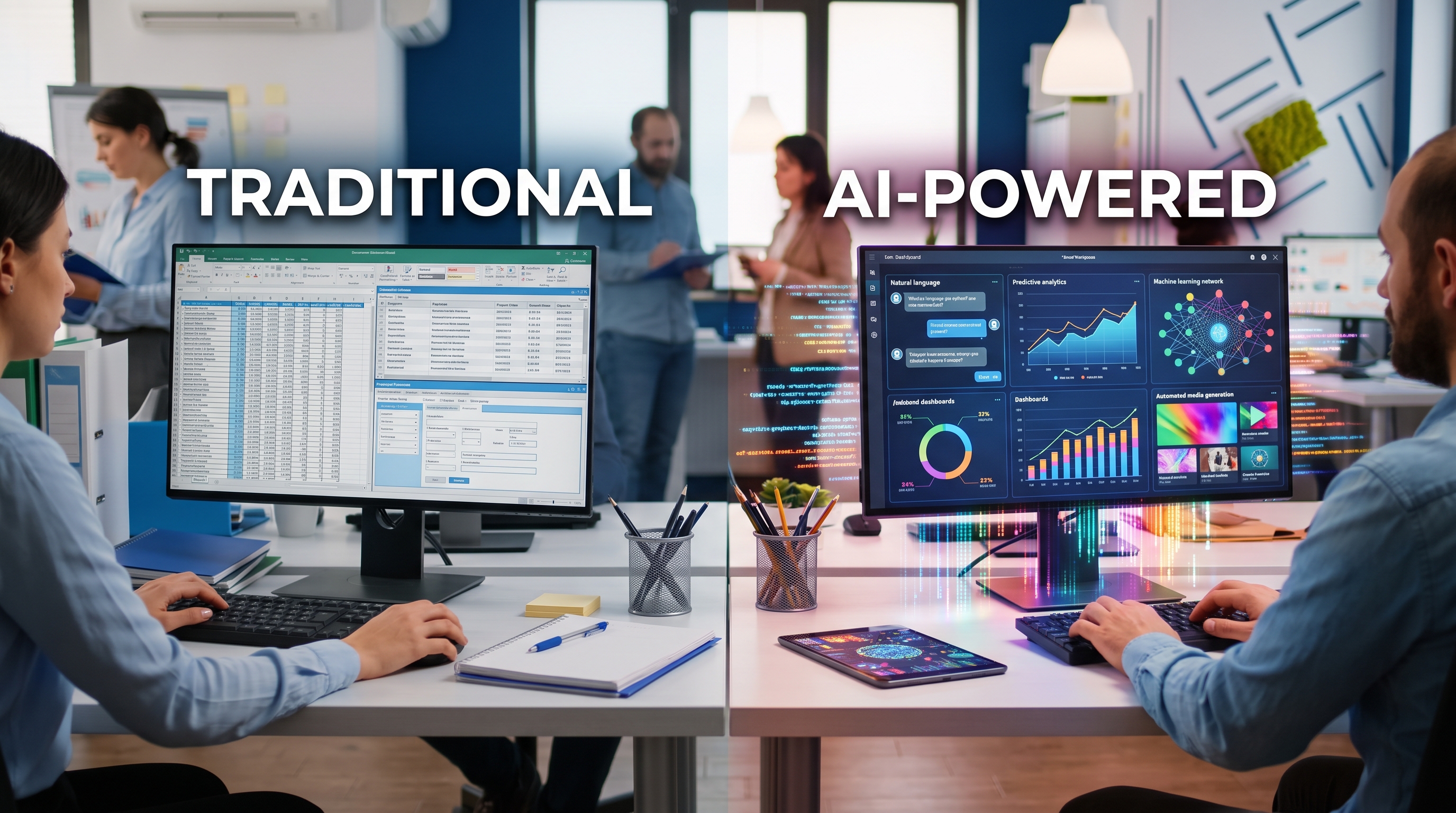
Traditional business software operates on deterministic logic and static rules. A relational database, an inventory spreadsheet, or an accounting ledger follows strict inputs: if event A occurs, the system executes command B. These platforms excel at structured data management, standardized reporting, and compliance audits where predictable outcomes are required.
In contrast, modern artificial intelligence software relies on probabilistic machine learning models, large language models (LLMs), and natural language processing. Instead of simply recording data, AI tools analyze patterns, generate synthetic media or text, categorize customer queries, and adapt through continual learning. Traditional software provides reliable execution, while artificial intelligence tools provide synthesis and autonomous support.
Key Feature Comparison
The operational distinctions between both software paradigms influence staffing, resource allocation, and budget planning.
| Feature Dimension | Traditional Business Software | AI-Powered Business Tools |
|Logic Model| Rule-based, deterministic | Probabilistic, pattern recognition |
| Data Handling | Structured tables and fields | Unstructured text, audio, and visual data |
| User Interaction | Manual dashboards, menus, forms | Natural language interfaces, prompts |
| Task Execution | Static workflows requiring human direction | Autonomous task completion, predictive actions |
| Output Variance| Identical results for identical inputs | Dynamic, context-dependent outputs |
| Complete SEO Article
Selecting the right digital infrastructure often decides how quickly an organization scales. Small companies today must weigh adaptive intelligent platforms against deterministic legacy systems. Evaluating the best ai tools for small business operations requires understanding where generative and predictive algorithms outperform traditional applications, and where standard software remains essential.
How AI Tools Differ from Traditional Software
Traditional business software operates on deterministic logic and static rules. A relational database, an inventory spreadsheet, or an accounting ledger follows strict inputs: if event A occurs, the system executes command B. These platforms excel at structured data management, standardized reporting, and compliance audits where predictable outcomes are required.
In contrast, modern artificial intelligence software relies on probabilistic machine learning models, large language models (LLMs), and natural language processing. Instead of simply recording data, AI tools analyze patterns, generate synthetic media or text, categorize customer queries, and adapt through continual learning. Traditional software provides reliable execution, while artificial intelligence tools provide synthesis and autonomous support.
Key Feature Comparison
The operational distinctions between both software paradigms influence staffing, resource allocation, and budget planning.
| Feature Dimension | Traditional Business Software | AI-Powered Business Tools |
| Logic Model | Rule-based, deterministic | Probabilistic, pattern recognition |
| Data Handling | Structured tables and fields | Unstructured text, audio, and visual data |
| User Interaction | Manual dashboards, menus, forms | Natural language interfaces, prompts |
| Task Execution | Static workflows requiring human direction | Autonomous task completion, predictive actions |
| Complete SEO Article
Selecting the right digital infrastructure often decides how quickly an organization scales. Small companies today must weigh adaptive intelligent platforms against deterministic legacy systems. Evaluating the **best ai tools for small business** operations requires understanding where generative and predictive algorithms outperform traditional applications, and where standard software remains essential.
How AI Tools Differ from Traditional Software
Traditional business software operates on deterministic logic and static rules. A relational database, an inventory spreadsheet, or an accounting ledger follows strict inputs: if event A occurs, the system executes command B. These platforms excel at structured data management, standardized reporting, and compliance audits where predictable outcomes are required.
In contrast, modern artificial intelligence software relies on probabilistic machine learning models, large language models (LLMs), and natural language processing. Instead of simply recording data, AI tools analyze patterns, generate synthetic media or text, categorize customer queries, and adapt through continual learning. Traditional software provides reliable execution, while artificial intelligence tools provide synthesis and autonomous support.
Key Feature Comparison
The operational distinctions between both software paradigms influence staffing, resource allocation, and budget planning.
| Feature Dimension | Traditional Business Software | AI-Powered Business Tools |
| **Logic Model** | Rule-based, deterministic | Probabilistic, pattern recognition |
| **Data Handling** | Structured tables and fields | Unstructured text, audio, and visual data |
| **User Interaction** | Manual dashboards, menus, forms | Natural language interfaces, prompts |
| **Task Execution** | Static workflows requiring human direction | Autonomous task completion, predictive actions |
| **Output Variance** | Identical results for identical inputs | Dynamic, context-dependent outputs |
| **Deployment Cost** | Predictable per-seat or perpetual licenses | Token-based usage, compute tiers, or API calls |
Assessing the Top AI Tools for Small Business Management
Smaller enterprises operate with constrained headcounts. Integrating targeted cognitive tools allows lean teams to automate repetitive administrative and analytical burdens.
The most effective business applications focus on three core areas:
- Customer Support and Engagement: Generative chatbots handle multi-turn customer inquiries around the clock. Unlike traditional rule-based chat scripts that break on unexpected questions, language models interpret intent, parse conversational context, and resolve tier-one tickets without manual intervention.
- Marketing and Media Asset Production: Content generation suites assist teams in drafting email campaigns, generating social media assets, and producing visual content. These platforms streamline copywriting and image drafting, reducing turnaround times for campaign launches.
Predictive Analytics and Financial Planning: AI-assisted financial modeling platforms analyze cash flow patterns, flag invoice anomalies, and forecast inventory needs based on historical sales trends. This frees owners from manual spreadsheet reconciliations.
Implementation Costs and Resource Constraints
Cost predictability remains a major difference between traditional platforms and AI applications. Standard enterprise software typically uses transparent per-user monthly subscription tiers or one-time license fees. Budgeting remains straightforward because operational expenses scale predictably with staff count.
Artificial intelligence software often couples monthly subscriptions with consumption-based compute pricing, API credits, or token limits. Workflows requiring high-volume data extraction or continuous language processing can generate variable month-to-month invoices. Furthermore, AI deployments demand ongoing output oversight. Small business teams must factor in human review time to prevent factual inaccuracies and protect sensitive proprietary information.
Balancing Automation with Stability
Modern organizations rarely face an all-or-nothing choice. The most resilient operations build a hybrid technology stack. Core accounting, payroll, and compliance records continue to belong in traditional deterministic systems where absolute precision is mandatory.
Simultaneously, layering autonomous AI solutions on top of that foundation accelerates customer communications, content production, and business intelligence. By identifying operational bottlenecks first, business leaders can deploy automation strategically rather than adopting technology for its own sake.
Frequently Asked Questions
Can AI tools completely replace traditional office software?
No. Traditional software remains indispensable for deterministic tasks such as general ledger accounting, regulatory compliance, and core database management. AI tools supplement standard applications by parsing unstructured files and generating analytical insights.
What are the primary dangers associated with integrating AI technologies into processes for small businesses?
The primary risks involve factual hallucinations, variable usage fees, and data privacy vulnerabilities. Teams should verify automated outputs and confirm vendor policies regarding whether business data is used to train public models.
How can small firms decide whether to purchase off-the-shelf software or create a custom AI tool?
Most small companies gain better return on investment by subscribing to proven SaaS platforms with native AI capabilities. Building custom models requires dedicated machine learning engineers, high-performance computing hardware, and clean training datasets that rarely justify the expense for lean teams.
Secondary Keywords
- ai vs traditional software
- business software automation
- small business productivity tools
- ai implementation costs
- business workflow automation
enterprise software vs ai
NLP Terms Used in the Article
- deterministic logic
- machine learning models
- large language models (LLMs)
- natural language processing
- structured data
- unstructured text
- predictive analytics
- API credits
- hallucinations
technology stack
Internal Linking Opportunities
| Anchor Text | Suggested Related Topic | Why It Fits |
| **hybrid technology stack** | How to Audit and Modernize Your Business Tech Stack | Helps readers plan the practical integration of new software into existing infrastructure. |
| **data privacy vulnerabilities** | Small Business Data Security: Best Practices for Cloud Tools | Directs readers to security safeguards when sharing internal business data with third-party software. |
| **workflow automation** | 5 Ways Lean Teams Use Workflow Automation to Scale | Offers concrete, step-by-step examples of businesstask automation. |---
** | Identical results for identical inputs | Dynamic, context-dependent outputs |
| **Deployment Cost** | Predictable per-seat or perpetual licenses | Token-based usage, compute tiers, or API calls |
Assessing the Top AI Tools for Small Business Management
Smaller enterprises operate with constrained headcounts. Integrating targeted cognitive tools allows lean teams to automate repetitive administrative and analytical burdens.
The most effective business applications focus on three core areas:
- Customer Support and Engagement: Generative chatbots handle multi-turn customer inquiries around the clock. Unlike traditional rule-based chat scripts that break on unexpected questions, language models interpret intent, parse conversational context, and resolve tier-one tickets without manual intervention.
- Marketing and Media Asset Production: Content generation suites assist teams in drafting email campaigns, generating social media assets, and producing visual content. These platforms streamline copywriting and image drafting, reducing turnaround times for campaign launches.
Predictive Analytics and Financial Planning: AI-assisted financial modeling platforms analyze cash flow patterns, flag invoice anomalies, and forecast inventory needs based on historical sales trends. This frees owners from manual spreadsheet reconciliations.
Implementation Costs and Resource Constraints
Cost predictability remains a major difference between traditional platforms and AI applications. Standard enterprise software typically uses transparent per-user monthly subscription tiers or one-time license fees. Budgeting remains straightforward because operational expenses scale predictably with staff count.
Artificial intelligence software often couples monthly subscriptions with consumption-based compute pricing, API credits, or token limits. Workflows requiring high-volume data extraction or continuous language processing can generate variable month-to-month invoices. Furthermore, AI deployments demand ongoing output oversight. Small business teams must factor in human review time to prevent factual inaccuracies and protect sensitive proprietary information.
Balancing Automation with Stability
Modern organizations rarely face an all-or-nothing choice. The most resilient operations build a hybrid technology stack. Core accounting, payroll, and compliance records continue to belong in traditional deterministic systems where absolute precision is mandatory.
Simultaneously, layering autonomous AI solutions on top of that foundation accelerates customer communications, content production, and business intelligence. By identifying operational bottlenecks first, business leaders can deploy automation strategically rather than adopting technology for its own sake.
Frequently Asked Questions
Can AI tools completely replace traditional office software?
No. Traditional software remains indispensable for deterministic tasks such as general ledger accounting, regulatory compliance, and core database management. AI tools supplement standard applications by parsing unstructured files and generating analytical insights.
What are the primary dangers associated with integrating AI technologies into processes for small businesses?
The primary risks involve factual hallucinations, variable usage fees, and data privacy vulnerabilities. Teams should verify automated outputs and confirm vendor policies regarding whether business data is used to train public models.
How can small firms decide whether to purchase off-the-shelf software or create a custom AI tool?
Most small companies gain better return on investment by subscribing to proven SaaS platforms with native AI capabilities. Building custom models requires dedicated machine learning engineers, high-performance computing hardware, and clean training datasets that rarely justify the expense for lean teams
Secondary Keywords
- ai vs traditional software
- business software automation
- small business productivity tools
- ai implementation costs
- business workflow automation
enterprise software vs ai
NLP Terms Used in the Article
- deterministic logic
- machine learning models
- large language models (LLMs)
- natural language processing
- structured data
- unstructured text
- predictive analytics
- API credits
- hallucinations
technology stack
Internal Linking Opportunities
| Anchor Text | Suggested Related Topic | Why It Fits |
| **hybrid technology stack** | How to Audit and Modernize Your Business Tech Stack | Helps readers plan the practical integration of new software into existing infrastructure. |
| **data privacy vulnerabilities** | Small Business Data Security: Best Practices for Cloud Tools | Directs readers to security safeguards when sharing internal business data with third-party software. |
| **workflow automation** | 5 Ways Lean Teams Use Workflow Automation to Scale | Offers concrete, step-by-step examples of businesstask automation. |
| Predictable per-seat or perpetual licenses | Token-based usage, compute tiers, or API calls |
Assessing the Top AI Tools for Small Business Management
Smaller enterprises operate with constrained headcounts. Integrating targeted cognitive tools allows lean teams to automate repetitive administrative and analytical burdens.
The most effective business applications focus on three core areas:
- Customer Support and Engagement: Generative chatbots handle multi-turn customer inquiries around the clock. Unlike traditional rule-based chat scripts that break on unexpected questions, language models interpret intent, parse conversational context, and resolve tier-one tickets without manual intervention.
- Marketing and Media Asset Production: Content generation suites assist teams in drafting email campaigns, generating social media assets, and producing visual content. These platforms streamline copywriting and image drafting, reducing turnaround times for campaign launches.
Predictive Analytics and Financial Planning: AI-assisted financial modeling platforms analyze cash flow patterns, flag invoice anomalies, and forecast inventory needs based on historical sales trends. This frees owners from manual spreadsheet reconciliations.
Implementation Costs and Resource Constraints
Cost predictability remains a major difference between traditional platforms and AI applications. Standard enterprise software typically uses transparent per-user monthly subscription tiers or one-time license fees. Budgeting remains straightforward because operational expenses scale predictably with staff count.
Artificial intelligence software often couples monthly subscriptions with consumption-based compute pricing, API credits, or token limits. Workflows requiring high-volume data extraction or continuous language processing can generate variable month-to-month invoices. Furthermore, AI deployments demand ongoing output oversight. Small business teams must factor in human review time to prevent factual inaccuracies and protect sensitive proprietary information.
Balancing Automation with Stability
Modern organizations rarely face an all-or-nothing choice. The most resilient operations build a hybrid technology stack. Core accounting, payroll, and compliance records continue to belong in traditional deterministic systems where absolute precision is mandatory.
Simultaneously, layering autonomous AI solutions on top of that foundation accelerates customer communications, content production, and business intelligence. By identifying operational bottlenecks first, business leaders can deploy automation strategically rather than adopting technology for its own sake.
Frequently Asked Questions
Can AI tools completely replace traditional office software?
No. Traditional software remains indispensable for deterministic tasks such as general ledger accounting, regulatory compliance, and core database management. AI tools supplement standard applications by parsing unstructured files and generating analytical insights.
What are the primary dangers associated with integrating AI technologies into processes for small businesses?
The primary risks involve factual hallucinations, variable usage fees, and data privacy vulnerabilities. Teams should verify automated outputs and confirm vendor policies regarding whether business data is used to train public models.
How can small firms decide whether to purchase off-the-shelf software or create a custom AI tool?
Most small companies gain better return on investment by subscribing to proven SaaS platforms with native AI capabilities. Building custom models requires dedicated machine learning engineers, high-performance computing hardware, and clean training datasets that rarely justify the expense for lean teams.
Secondary Keywords
- ai vs traditional software
- business software automation
- small business productivity tools
- ai implementation costs
- business workflow automation
enterprise software vs ai
NLP Terms Used in the Article
- deterministic logic
- machine learning models
- large language models (LLMs)
- natural language processing
- structured data
- unstructured text
- predictive analytics
- API credits
- hallucinations
technology stack
Internal Linking Opportunities
| Anchor Text | Suggested Related Topic | Why It Fits |
| **hybrid technology stack** | How to Audit and Modernize Your Business Tech Stack | Helps readers plan the practical integration of new software into existing infrastructure. |
| **data privacy vulnerabilities** | Small Business Data Security: Best Practices for Cloud Tools | Directs readers to security safeguards when sharing internal business data with third-party software. |
| **workflow automation** | 5 Ways Lean Teams Use Workflow Automation to Scale | Offers concrete, step-by-step examples of businesstask automation. |