

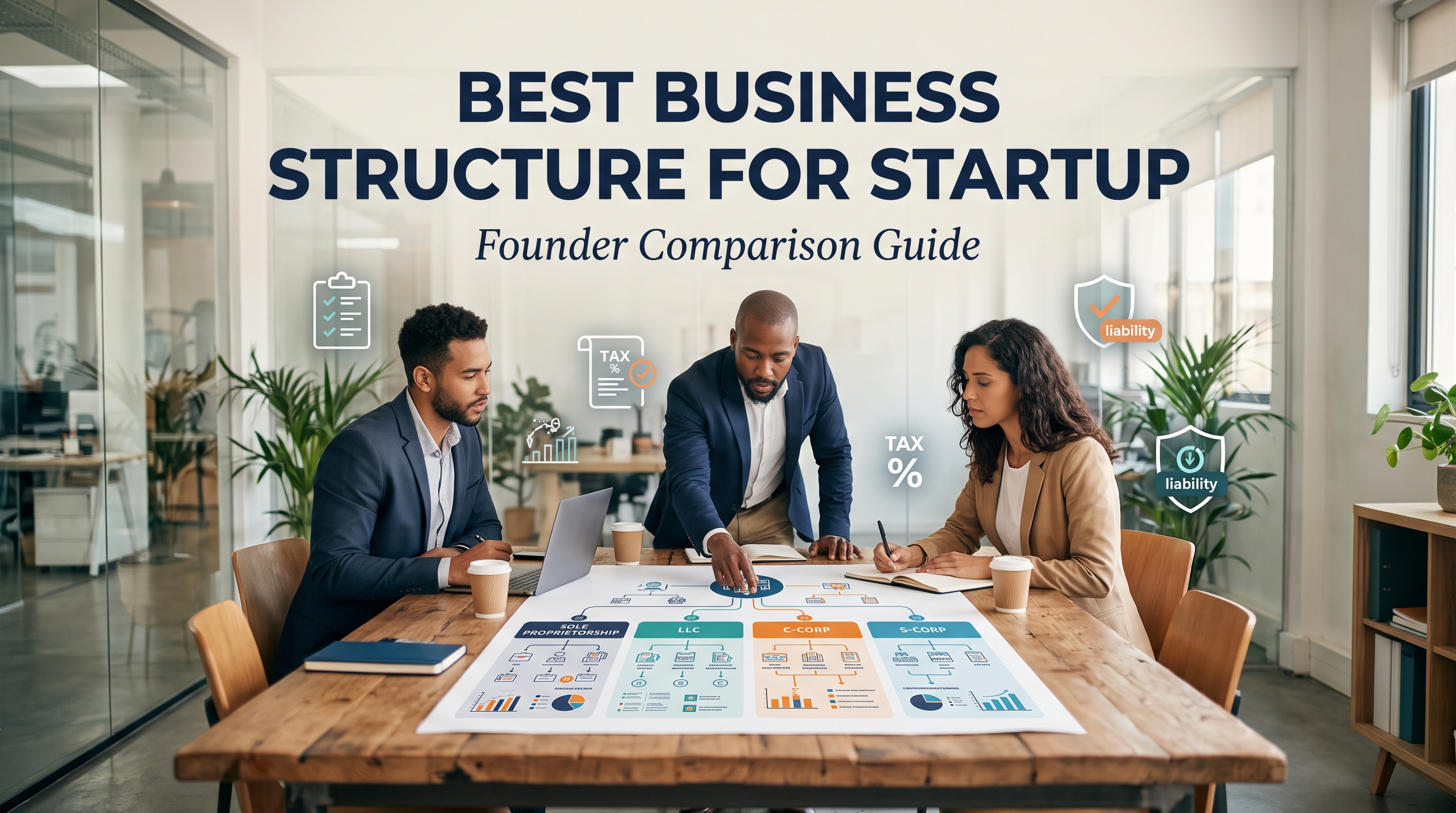
Selecting the right legal entity sets the foundation for funding, daily operations, and long-term compliance. For early-stage founders, identifying the best business structure for startup growth depends on how you plan to raise capital, manage taxes, and protect personal wealth. Making an informed choice early prevents expensive restructuring later.
Selecting the Best Business Structure for the Development of Startups
Choosing an entity is not a one-size-fits-all decision. The four primary options vary significantly across legal liability, tax treatments, and ownership arrangements.
1. Sole Proprietorship
A sole proprietorship is the simplest setup. If you launch a venture without filing entity paperwork, your business defaults to this model.
- Liability: You carry unlimited personal liability for business obligations and lawsuits.
- Taxes: Earnings flow directly to your personal income tax return via Schedule C.
Ideal Use: Low-risk solo ventures, freelancers, and small side projects testing initial demand.
2. Limited Liability Company (LLC)
Personal asset protection and administrative ease are combined in an LLC. It isolates personal assets from company debts and contractual disputes.
- Liability: Members enjoy limited liability protection. Personal property remains shielded from general business creditors.
- Taxes: LLCs benefit from pass-through taxation by default. Profit passes directly to owners without corporate income tax.
Ideal Use: Bootstrapped ventures, agencies, e-commerce shops, and service firms seeking operational flexibility without formal board requirements.
3. C-Corporation (C-Corp)
A C-corp is a distinct legal corporation that its shareholders own. Before making an investment, the majority of venture capital funds want this structure.
- Liability: Shareholders, directors, and officers enjoy strong liability shielding.
- Taxes: Subject to corporate income tax. Profits face corporate-level tax, and dividends face shareholder-level tax.
Ideal Use: High-growth startups seeking institutional equity investment, venture capital, or planning to issue stock options to employees.
4. S-Corporation (S-Corp)
The IRS allows qualified LLCs and C-corps to choose an S-corp tax classification.
- Liability: Mirrors the underlying entity structure (LLC or corporation).
- Taxes: Avoids corporate double taxation through pass-through rules while reducing self-employment taxes via reasonable owner salaries.
Ideal Use: Profitable domestic ventures with fewer than 100 individual shareholders.
Startup Entity Comparison
| Entity Type | Personal Liability | Tax Treatment | Outside Funding Potential | Setup Complexity |
|Unlimited |Pass-through |Minimal |Low |**Sole Proprietorship** |
| **LLC** | Limited | Pass-through | Moderate (Angels) | Low–Moderate |
| **C-Corp** | Limited | Corporate (Double tax potential) | High (VC & Institutional) | High |
| **S-Corp** | Limited | Pass-through | Low–Moderate (Strict caps) | Moderate–High |
Key Factors When Choosing Your Structure
Four essential criteria should guide your final decision:
- Fundraising Plans: If you intend to pitch venture capital firms or join an accelerator, a Delaware C-corp remains the market standard. Venture firms rarely invest directly in pass-through LLCs due to tax and equity allocation rules.
- Asset Protection: If your product or service carries liability risks, avoid sole proprietorships. Both LLCs and corporations establish a distinct legal boundary between personal property and company debt.
- Tax Efficiency: Early-stage startups operating at a loss often benefit from pass-through entities. Subject to IRS restrictions, these losses may be used to offset other income.
Equity Incentives: Corporations easily grant stock options, restricted stock units, and incentive shares to attract technical talent. Distributing equity in an LLC requires complex partnership unit agreements.
Next Steps for Founders
Your entity choice influences every operational stage, from opening a merchant bank account to signing commercial contracts. Bootstrapped businesses usually thrive with the lightweight flexibility of an LLC. Startups targeting rapid scale and multi-stage venture financing should establish a C-corp early. Consult a corporate attorney and a certified public accountant to align your choice with local regulations and tax rules.
Frequently Asked Questions
Can an LLC later become a C-corp?
Yes. Many founders launch as an LLC to minimize fees and later execute a statutory conversion or merger into a Delaware C-corp when raising institutional capital.
Why are Delaware C-corps preferred by institutional investors?
Delaware features established corporate case law, a specialized Court of Chancery, and predictable corporate governance standards that institutional investors prefer.
Does a single-member LLC require separate business tax filing?
A single-member LLC is automatically recognized as a disregarded entity for federal income tax purposes. The owner reports revenue and expenses directly on personal income tax filings unless electing corporate tax treatment.
Secondary Keywords
- business legal entities
- startup entity selection
- llc vs c corp
- sole proprietorship vs llc
- small business incorporation
startup tax structure
NLP Terms Used in the Article
- legal entity
- venture capital
- personal liability
- pass-through taxation
- corporate income tax
- asset protection
- stock options
- Delaware C-corp
- statutory conversion
- corporate governance
disregarded entity
Internal Linking Opportunities
| Anchor Text | Suggested Related Topic | Why It Fits |
| Delaware C-corp | Delaware vs. Home State Incorporation Guide | Helps founders decide whether to incorporate out-of-state or locally. |
| pass-through taxation | Small Business Tax Planning Basics | Explains how business earnings impact individual personal tax returns. |
| stock options | Guide to Startup Equity and Vesting Schedules | Provides context on attracting early employees with equity incentives. |