

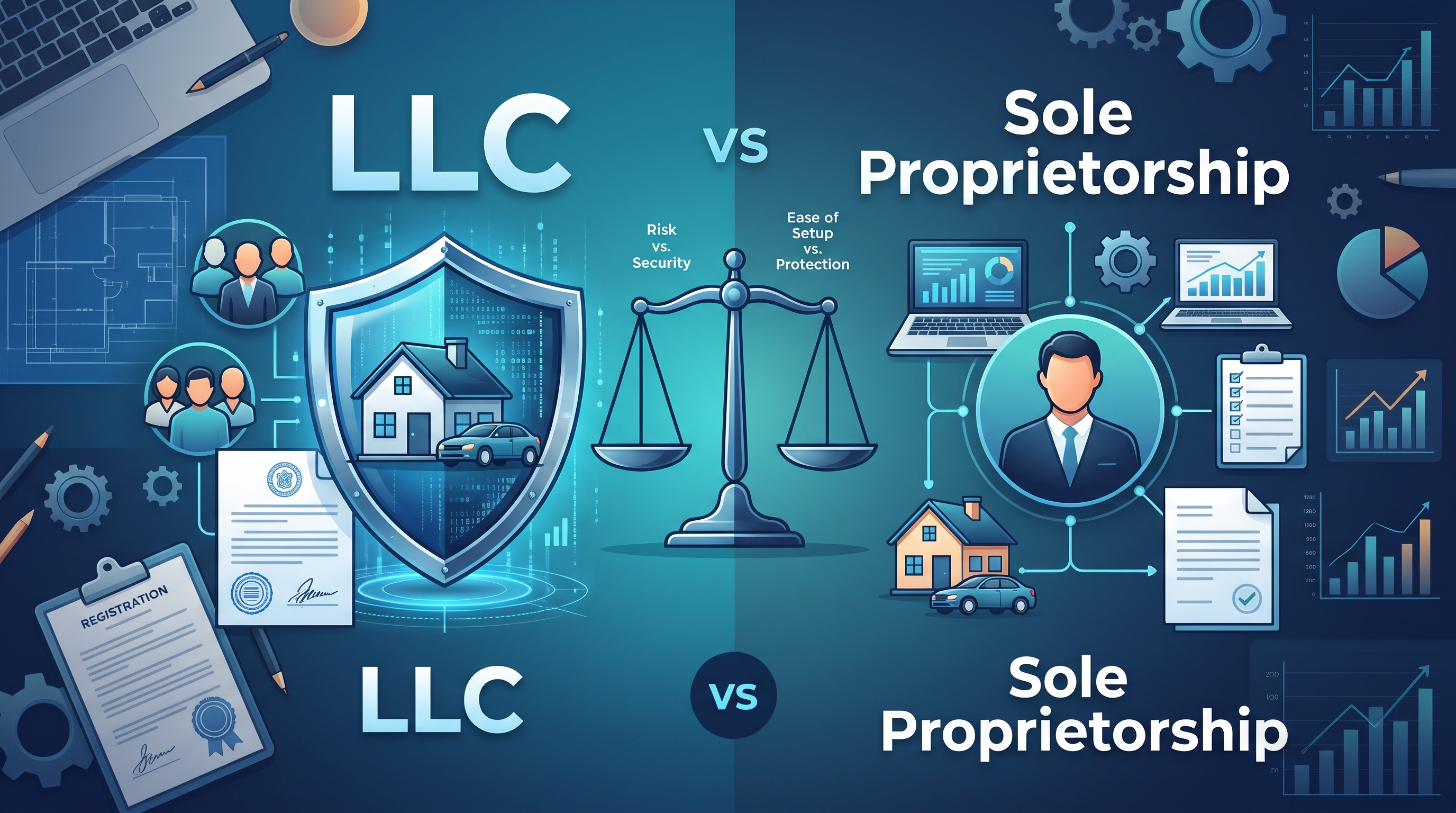
Choosing the right legal structure is one of the earliest and most consequential decisions you will make when launching a business. For many founders, independent contractors, and small business owners, the debate narrows down to an llc vs sole proprietorship. Both structures allow you to operate a commercial enterprise and generate revenue, but they handle personal risk, ongoing compliance, taxes, and credibility in fundamentally different ways.
The right choice depends on your appetite for risk, your budget, and where you envision your business heading over the next several years.
Understanding the Fundamental Difference
At its simplest, the core difference between llc and sole proprietorship lies in legal separation.
A sole proprietorship is an unincorporated entity where the business and the individual owner are legally the exact same party. If you start offering freelance consulting, landscaping, or web development services today without filing formal organizational paperwork with your state, you are operating as a sole proprietor by default.
In contrast, a Limited Liability Company (LLC) is a distinct legal entity created under state law. Establishing an LLC requires filing formal formation documents, typically called Articles of Organization or a Certificate of Formation, and paying state registration fees. By creating an LLC, you establish a clear boundary between your business operations and your personal life.
Personal Liability: The Shield That Sets Them Apart
The most significant distinction between these two models is how they treat personal liability.
In a sole proprietorship, there is no corporate veil. Because you and the business are legally synonymous, your personal assets—including your home, personal savings accounts, vehicles, and investments—are entirely exposed to business debts and legal claims. If a client sues you for breach of contract, a customer slips at your workshop, or the enterprise defaults on a supplier invoice, creditors can target your personal property to satisfy those obligations.
An LLC introduces a protective barrier known as limited liability protection. When properly maintained, an LLC shields your personal belongings from the liabilities of the enterprise. If the business incurs substantial debt or faces a lawsuit, claims are typically restricted to the assets owned directly by the LLC, such as its dedicated business bank accounts, inventory, or equipment.
However, this shield is not impenetrable. A business owner can lose this protection—a scenario courts refer to as "piercing the corporate veil"—if they mix personal and business finances, commit intentional fraud, or fail to observe basic corporate formalities.
Tax Treatment and Flexibility
Taxes represent another vital area of comparison, though the day-to-day difference for a single-owner operation is often smaller than many realize.
By default, both a sole proprietorship and a single-member LLC utilize pass-through taxation:
- Sole Proprietorship: Business profits and losses flow directly to your individual tax return. You report net earnings on Schedule C of IRS Form 1040 and pay standard self-employment taxes (covering Social Security and Medicare) along with ordinary income tax.
- Single-Member LLC: The IRS treats a standard single-member LLC as a "disregarded entity" for tax purposes. Profits and losses pass through to your personal return on Schedule C, exactly like a sole proprietorship.
The key advantage of an LLC emerges as your net income grows. Unlike a sole proprietorship, an LLC has the flexibility to elect corporate tax treatment. By filing an election with the IRS, an LLC can choose to be taxed as an S Corporation (S-Corp) or C Corporation (C-Corp).
Electing S-Corp status can provide notable savings on self-employment taxes once earnings surpass a reasonable compensation threshold. Under this approach, the owner draws a "reasonable salary" subject to payroll taxes, while remaining profits can be distributed as dividends, which are exempt from self-employment tax. A sole proprietorship cannot make this election.
Formation Costs and Administrative Burden
If simplicity and low upfront costs are your primary objectives, the sole proprietorship is unmatched:
- Setup and Filings: A sole proprietorship requires no state formation paperwork. Depending on local laws, you may only need a local business license or a "Doing Business As" (DBA) registration if you operate under a trade name instead of your legal name.
- Ongoing Compliance: There are no state annual reports, no formal corporate records, and minimal recurring government maintenance fees.
Forming and managing an LLC involves deliberate administrative effort:
- Initial Formation: You must draft and file Articles of Organization with your secretary of state, pay an initial filing fee (ranging from roughly $40 to several hundred dollars depending on the jurisdiction), and secure an Employer Identification Number (EIN).
- Operating Agreement: While not universally mandated by state statutes, drafting a thorough Operating Agreement is critical to outline ownership percentages, decision-making rights, and dispute procedures.
- Annual Maintenance: Many states require LLCs to submit annual or biennial reports and pay franchise taxes or recurring maintenance fees. You must also maintain separate business bank accounts and keep clean financial records to preserve your liability protection.
Comparing Both Structures
Feature | Sole Proprietorship | Limited Liability Company (LLC)
Legal Status | Unincorporated; owner and business are identical | Separate legal entity distinct from owner
Personal Liability | Unlimited personal liability for business debts | Limited liability; personal assets generally protected
Tax Flexibility | Pass-through taxation only (Schedule C) | Pass-through by default; option to elect S-Corp or C-Corp
Setup Cost | Low to none (basic licenses only) | Moderate ($40 to $500+ depending on state)
Ongoing Filings | Minimal; no state annual reports required | Annual or biennial reports, franchise taxes in many states
Brand Credibility | Basic; tied directly to individual name or DBA | Higher; entity suffix conveys permanence and professionalism
Credibility and Future Growth
Perception matters in competitive markets. Holding an "LLC" suffix behind your company name signals to vendors, banks, and potential clients that you run an established, registered organization.
Certain commercial partners and corporate clients prefer contracting solely with registered corporate entities rather than individuals to minimize their own compliance risks regarding independent contractor classifications. Moreover, banks often have clearer frameworks for extending commercial credit lines to formal legal entities, and bringing on future equity partners is far simpler within an LLC framework.
How to Decide Which Structure Fits You
Choosing between an LLC and a sole proprietorship comes down to evaluating three distinct factors:
- Your Risk Exposure: If you work in an industry with negligible liability risk—such as freelance writing, basic graphic design, or occasional digital consulting without major contractual liability—a sole proprietorship can be a sensible, cost-effective starting point. Conversely, if you produce physical goods, employ staff, lease commercial space, or provide services where operational errors could trigger financial damages, an LLC's personal protection is indispensable.
- Your Current Budget: Founders testing an unproven concept on a tight budget often launch as sole proprietors to validate demand without spending capital on formation fees and annual reports.
- Your Scaling Intentions: If you plan to scale, hire employees, take on commercial debt, or seek outside investment, establishing an LLC from day one prevents the administrative friction of restructuring accounts, contracts, and payment processors later.
Business structures are not permanent. Many successful entrepreneurs begin as sole proprietors during their earliest proof-of-concept phase and transition into an LLC once operations gain consistent momentum and customer revenue.
Frequently Asked Questions
Can I convert a sole proprietorship to an LLC later?
Yes. You can transition from a sole proprietorship to an LLC at any point by filing Articles of Organization with your state, obtaining a new EIN from the IRS, opening separate business accounts, and transferring existing commercial contracts to the new company.
Does an LLC require a separate bank account?
Yes. Maintaining strict financial separation between personal funds and company revenue is essential. Commingling funds can void your liability protection in court and expose your personal savings to business debts.
Do I pay less tax with an LLC than with a sole proprietorship?
By default, no. Both single-member LLCs and sole proprietorships pay identical pass-through tax rates. However, an LLC gives you the legal option to elect S Corporation status, which can lower self-employment taxes once your business generates significant, steady net income.
Is business insurance enough if I remain a sole proprietor?
While general liability and professional liability insurance provide valuable financial cushions against specific claims, insurance policies have exclusions, claim limits, and deductibles. They do not eliminate personal responsibility for uninsured debts or commercial obligations the way an LLC does.