
Starting a company is an ambitious milestone, but not every new commercial venture follows the same playbook. When founders sit down to launch, one fundamental question sets the trajectory of their organization: what is a startup, and how does it fundamentally differ from a traditional small business?
While people often use the terms interchangeably, they represent two distinct operational philosophies. A local boutique, an accounting consultancy, and a high-growth artificial intelligence platform are all newly created enterprises, yet they pursue radically different goals. Understanding the deeper startup meaning helps entrepreneurs, managers, and investors choose the right capital structure, organizational rhythm, and long-term vision.
Defining the Core Concept: What Is a Startup?
At its core, a startup is a temporary organization designed to search for a repeatable, scalable business model under conditions of extreme uncertainty. Rather than opening a company based on proven market formulas, a startup develops an innovative product, technology, or workflow intended to solve an unmet need across an expansive market.
Founders typically begin by building a Minimum Viable Product (MVP) to test their value hypothesis with initial users. Through customer feedback and rapid experimentation, the team validates product-market fit before pouring capital into rapid expansion. Because the product is novel and the market dynamics are unproven, startups operate with significant operational risk. However, when successful, their proprietary advantages—such as software automation, network effects, or patented intellectual property—allow them to scale exponentially without a matching increase in marginal delivery costs.
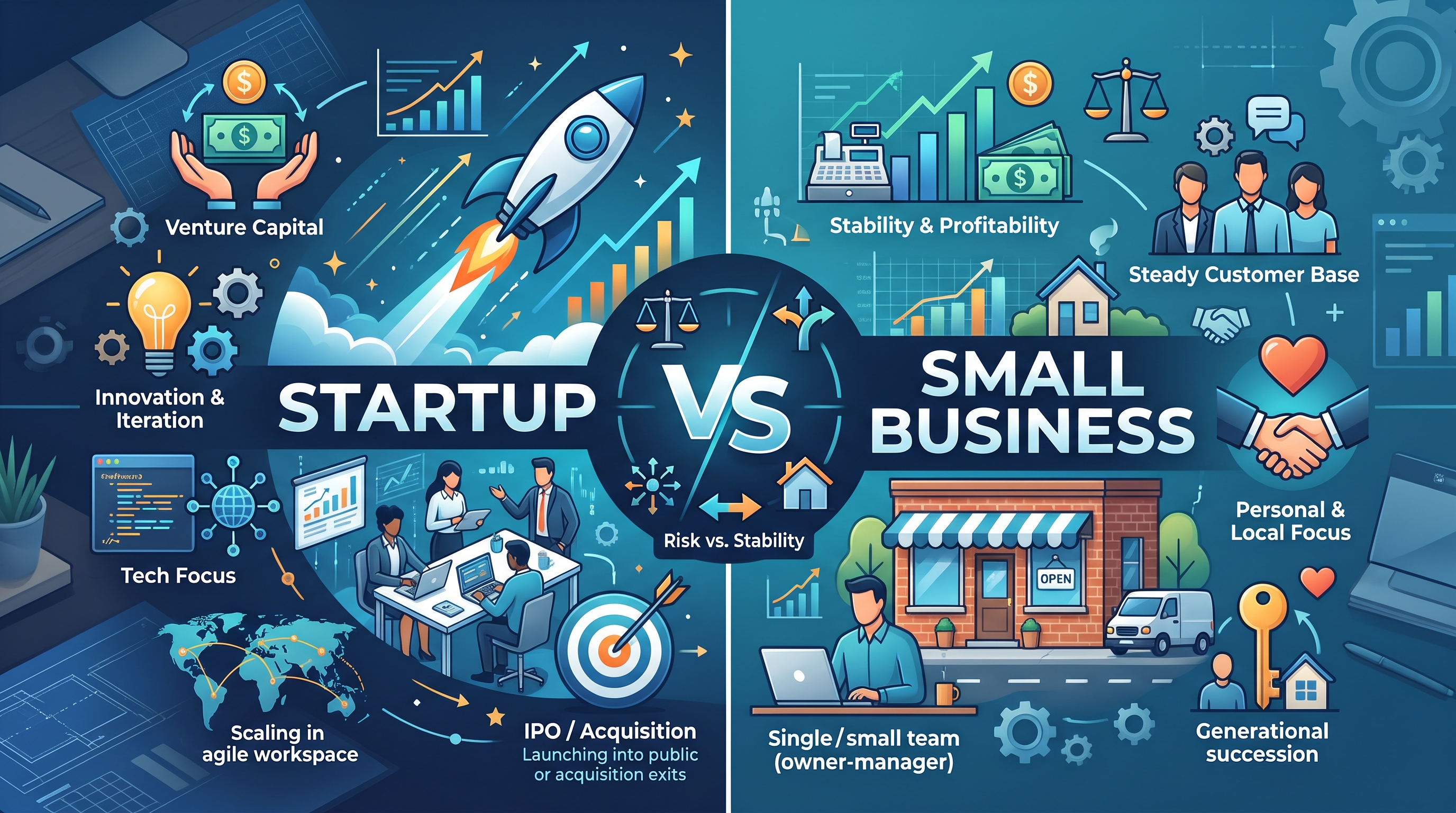
Core Differences: Startup vs Small Business
The debate over startup vs small business is not about company prestige or dedication. It is about how each company defines success, handles financial resources, and structures daily operations.
┌───────────────────────┬────────────────────────────────────────┬────────────────────────────────────────┐
│ Strategic Dimension │ Startup │ Small Business │
├───────────────────────┼────────────────────────────────────────┼────────────────────────────────────────┤
│ Primary Objective │ Disrupt markets; hyper-scale globally │ Steady local/regional profitability │
│ Business Model │ Unproven, iterative, scalable │ Proven, established, execution-focused │
│ Financing Method │ Venture capital, angel rounds, equity │ Bank debt, SBA loans, owner cash flow │
│ Scalability Profile │ Exponential growth; low marginal costs │ Linear growth tied to headcount/assets │
│ Risk Tolerance │ High product and market failure rates │ Calculated operational risks │
│ Exit Strategy │ Acquisition (M&A) or Public IPO │ Generational transfer or retention │
└───────────────────────┴────────────────────────────────────────┴────────────────────────────────────────┘
1. Growth Ambition and Market Scope
A conventional small business targets a clearly defined, often regional customer base. A family-owned plumbing firm, independent dental practice, or neighborhood bistro focuses on delivering consistent value to a community. Market boundaries are primarily geographic, and leadership usually targets stable, single-digit or modest double-digit year-over-year revenue expansion.
Startups ignore geographic boundaries from inception. A fintech application or enterprise workflow platform is architected from day one to serve users across states, countries, and continents. The underlying mandate is hyper-growth, often requiring triple-digit annual revenue jumps during early expansion phases to capture dominant market share before competitors emerge.
2. Business Model and Scalability
Small businesses run on proven economic templates. An entrepreneur opening a commercial contracting agency knows how jobs are quoted, what labor costs represent, and how invoices are billed. Because standard operating procedures already exist across the industry, execution and quality control are the main challenges. However, revenue growth is inherently linear: handling double the clients requires hiring roughly double the staff or buying double the equipment.
Startups operate in uncharted territory. They experiment with unproven unit economics until they uncover a repeatable customer acquisition and onboarding system. Because software, digital infrastructure, or centralized distribution back their core offering, a startup can often onboard 50,000 new customers with negligible incremental expense, unlocking true operational leverage.
3. Funding Mechanics and Capital Structure
Financing illustrates one of the sharpest divides between both models:
- Startup Funding: Early-stage founders rarely qualify for standard commercial bank loans because they lack positive earnings before interest, taxes, depreciation, and amortization (EBITDA) or physical collateral. Instead, they sell company equity to angel investors, venture capital (VC) firms, and accelerators. These external backers inject substantial cash to fund rapid engineering, customer acquisition, and market capture, intentionally sustaining short-term operating losses to achieve future scale.
- Small Business Funding: Small business owners generally avoid diluting their ownership equity. They launch with personal savings, family contributions, lines of credit, or debt programs like Small Business Administration (SBA) loans. Capital is deployed directly into income-generating physical assets or immediate inventory, and early revenue is recycled to service debt and generate owner distributions.
4. Risk Profile and Operational Uncertainty
Because small businesses deliver known goods into existing markets, their survival largely depends on location, cost controls, service standards, and local demand. The operational blueprint is established, making baseline cash flow predictable once the initial customer base forms.
Startups face existential ambiguity. The core problem they aim to solve might not be painful enough for customers to pay for, or the technology might prove too difficult to commercialize reliably. Consequently, many venture-backed companies fail to survive their early validation phases. Those that successfully cross the gap, however, transform legacy industries and generate significant enterprise valuations.
5. Ultimate Exit and Succession Strategies
Small business owners typically build sustainable enterprises intended to deliver steady long-term income, support a comfortable lifestyle, or pass down through family generations. Selling the business usually involves private business brokers, management buyouts, or asset sales to local competitors.
By contrast, startup founders and their equity partners enter the venture with an explicit exit horizon, usually within five to ten years. Investors require a liquidity event to realize returns on their risk capital. Common terminal paths include strategic mergers and acquisitions (M&A) by larger corporations or initial public offerings (IPOs) on public stock exchanges.
Which Path Fits Your Vision?
Choosing between these two models requires honesty about your personal risk tolerance, financial expectations, and day-to-day work style.
Launch a small business if you prioritize maintaining complete equity ownership, establishing immediate profitability, and building a sustainable business that enriches your community. This framework allows you to control operational pacing without external board governance.
Pursue a startup if your vision requires solving a major systemic friction, building proprietary technology, and serving a worldwide audience. If you thrive amid ambiguity, are comfortable pitching institutional investors, and want to scale an enterprise rapidly, the startup track aligns with your ambitions.
Frequently Asked Questions
What does "startup meaning" imply in modern business?
In contemporary entrepreneurship, a startup refers to an agile business entity dedicated to discovering a repeatable, highly scalable business model. Rather than executing a standard retail or service blueprint, it leverages innovation and scalable technology to solve widespread problems in high-growth markets.
Can a small business evolve into a startup?
Yes. A small business can evolve into a startup if it transitions from a traditional service or retail framework into a scalable, tech-enabled model. For example, a local logistics agency that engineers a proprietary automated freight-matching algorithm and seeks venture financing to scale globally effectively pivots into a startup.
Do all startups require venture capital?
No. While many high-profile startups raise institutional venture capital to accelerate customer acquisition, some founders choose to bootstrap. Bootstrapped startups fund early expansion entirely out of customer revenue and reinvested cash flow while retaining scalable product architectures and large addressable markets.
How long does a company remain a startup?
A company typically sheds its startup label when it reaches mature operational stability. Common milestones include reaching sustainable positive cash flow, achieving a massive market capitalization, expanding past hundreds of employees, or executing a public stock offering or trade sale.