

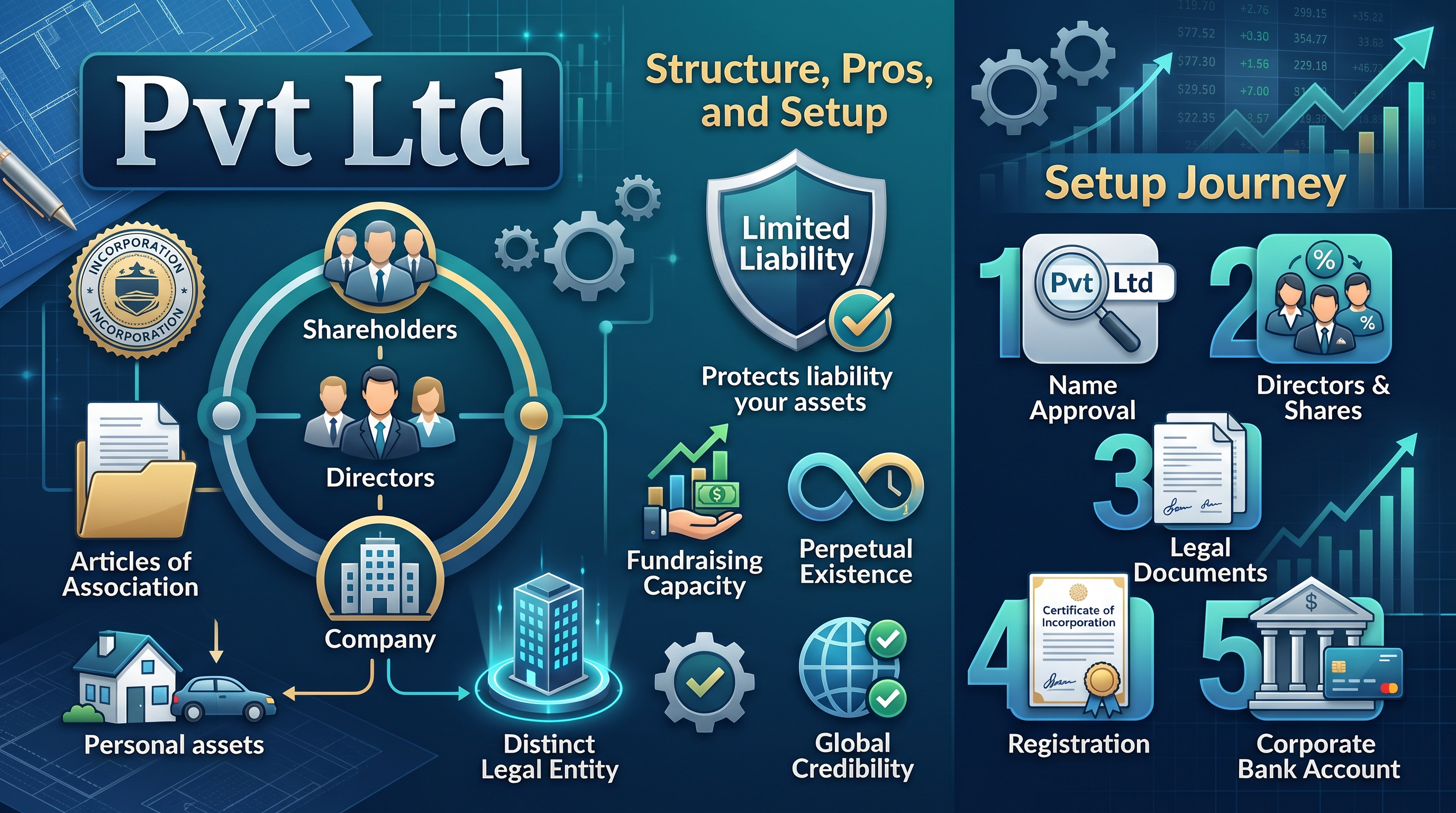
A private limited company is a privately held corporate entity that exists as an independent legal person distinct from its owners. Widely used by growing startups and established enterprises around the world, this structure limits the financial exposure of its shareholders to the nominal value of their invested capital. When founders evaluate long-term scalability, commercial credibility, and risk management, establishing a private limited company is often the foundational step in their corporate journey.
Understanding how this corporate form functions—along with its statutory requirements, governance model, and operational obligations—allows business leaders to make informed structural decisions from day one.
Core Definition and Pvt Ltd Meaning
To grasp the practical pvt ltd meaning, it helps to examine what the abbreviation represents across corporate registries in the United Kingdom, India, Singapore, and Commonwealth jurisdictions. "Pvt Ltd" stands for "private limited," indicating two essential legal qualities: the company is non-public, and member liability is strictly limited.
Unlike public companies, a private limited company cannot offer its shares, debentures, or debt securities to the general public through an open stock exchange. Ownership remains closely held among a defined circle of founders, early angel investors, venture funds, or family members. Any transfer of ownership interests typically requires formal board approval or consent under the company's internal articles of association.
At the same time, the entity enjoys perpetual succession. Because the business exists as a legal entity in its own right, changes in shareholding, executive resignations, or the passing of an owner do not dissolve the underlying enterprise. Contracts, real property, corporate bank accounts, and intellectual property remain securely registered under the company name rather than under personal ownership.
Key Structural Characteristics
Several fundamental characteristics distinguish a private limited company from general partnerships, sole proprietorships, and publicly traded corporations:
- Distinct Legal Personality: The entity can sue, be sued, execute commercial contracts, and incur debt under its corporate name.
- Restricted Share Transfers: Articles of association outline precise transfer mechanics, protecting existing founders against unwanted third-party share acquisitions.
- Shareholder Thresholds: Depending on regional company legislation, shareholder caps typically range from a minimum of two members up to a statutory ceiling of 50 or 200 members.
- Dual Governance Model: Shareholders provide the paid-up equity and retain ultimate voting power on major corporate actions, while appointed directors oversee daily operations, commercial contracts, and strategic compliance.
- Protected Financial Liability: If the company faces commercial insolvency or legal judgment, a shareholder's personal assets—such as residential real estate, personal savings, and family vehicles—cannot be seized to settle unpaid corporate debts.
Major Advantages of Private Limited Company Formation
Evaluating the advantages of private limited company registration reveals why modern technology startups and ambitious commercial firms favor this vehicle over unincorporated models.
Business Feature | Private Limited Company | Sole Proprietorship | General Partnership
Personal Liability | Limited to unpaid share value | Unlimited personal liability | Unlimited joint and several liability
Corporate Identity | Separate legal entity | Same as owner | Same as partners
Fundraising Capacity | Equity financing via share issuance | Limited to personal loans/cash | Limited to partner capital
Perpetual Existence | Indefinite until dissolved | Terminates upon owner's death | Dissolves upon partner exit/death
Ownership Transfer | Structured via share purchase | Asset sale only | Complex partner restructuring
Protected Capital Exposure
The primary motivation for incorporation is insulation against catastrophic commercial loss. When an entrepreneur operates as an unincorporated sole trader, personal finances remain directly exposed to trade obligations, commercial leases, and tort claims. Within a private limited structure, creditors can claim against only company-owned bank reserves and operational assets.
Superior Venture Fundraising
Institutional venture capital funds, family offices, and private equity syndicates rarely deploy early-stage capital into partnerships or sole proprietorships. A private company can issue preference shares, common equity, and convertible loan instruments with customized voting, dividend, and liquidation preferences. This structural clarity makes complex funding rounds straightforward for incoming institutional investors.
Market Credibility and Brand Equity
B2B enterprises, international corporate clients, and financial institutions view incorporated firms as stable commercial partners. Registration with a statutory authority requires transparent corporate disclosure, verified director identity filings, and regular financial accountability. This formal oversight builds confidence among tier-one vendors and enterprise clients.
Important Limitations to Consider
Despite its clear strategic benefits, a private company structure introduces operational constraints that may not fit every business model:
- Elevated Compliance Costs: Companies must maintain statutory registers, prepare annual financial statements, file corporate tax returns, and submit annual confirmation reports to corporate registries.
- Public Information Disclosure: While private firms enjoy far greater privacy than public corporations, registry filings such as director details, registered office addresses, and share capital figures remain accessible on official public databases.
- Restricted Capital Liquidity: Because shares cannot trade on open equity markets, founders and early employees cannot instantly liquidate equity stakes without secondary share buybacks or coordinated third-party transactions.
- Strict Regulatory Oversight: Directors carry formal fiduciary duties. Mismanaging company funds, trading while insolvent, or failing to file statutory records can lead to director disqualification, civil fines, or personal liability.
How to Form a Private Limited Company
While specific procedures vary across different regional authorities—such as Companies House in the UK or the Ministry of Corporate Affairs in India—the standard formation workflow involves clear structural steps.
Step 1: Choose Corporate Name & Verify Availability
Step 2: Appoint Directors & Issue Founding Shares
Step 3: Draft Articles of Association & Statutory Bylaws
Step 4: Register with Corporate Registry & Tax Authority
Step 5: Open Dedicated Corporate Bank Account
Founders begin by selecting an original commercial name that complies with national registry conventions. Next, the company files founding constitutional documents: the memorandum of association (stating the intention to form the company) and the articles of association (defining operational rules, director responsibilities, and voting thresholds).
Once official registration is granted, the company receives a corporate identification number and certificate of incorporation. Founders then establish a dedicated corporate bank account, fund initial share allotments, and register for mandatory payroll and sales tax accounts before commencing trade.
Frequently Asked Questions
Can one person own a private limited company?
In many modern jurisdictions, a single individual can incorporate a single-member or one-person company while retaining limited liability protection. However, some regions still mandate a minimum of two directors or two distinct shareholders to maintain corporate validity.
How does a private limited company differ from a public limited company?
A private limited company keeps its shares restricted to a private group of owners and cannot solicit investments from the public. A public limited company can trade its shares on public exchanges, must meet strict financial reporting regulations, and usually faces much higher minimum capital requirements.
Do owners pay personal income tax on company profits?
No, the company itself pays corporate income tax directly on its net profits. Shareholders owe personal income tax only when company profits are distributed to them as dividends, director salaries, or formal consulting fees.
Is a private limited company the same as an LLC?
They serve equivalent commercial purposes, but their regulatory frameworks differ. A limited liability company (LLC) is a popular United States corporate entity that offers pass-through taxation by default. A private limited company is the standard model in Commonwealth and international systems, operating with dedicated statutory boards and traditional corporate share structures.